Everyone Is Learning How. Almost Nobody Is Asking Why.
The how is the easy part. AI can generate answers, but it depends entirely on you knowing what you're trying to accomplish and why. Most people skip that part.
Freddy
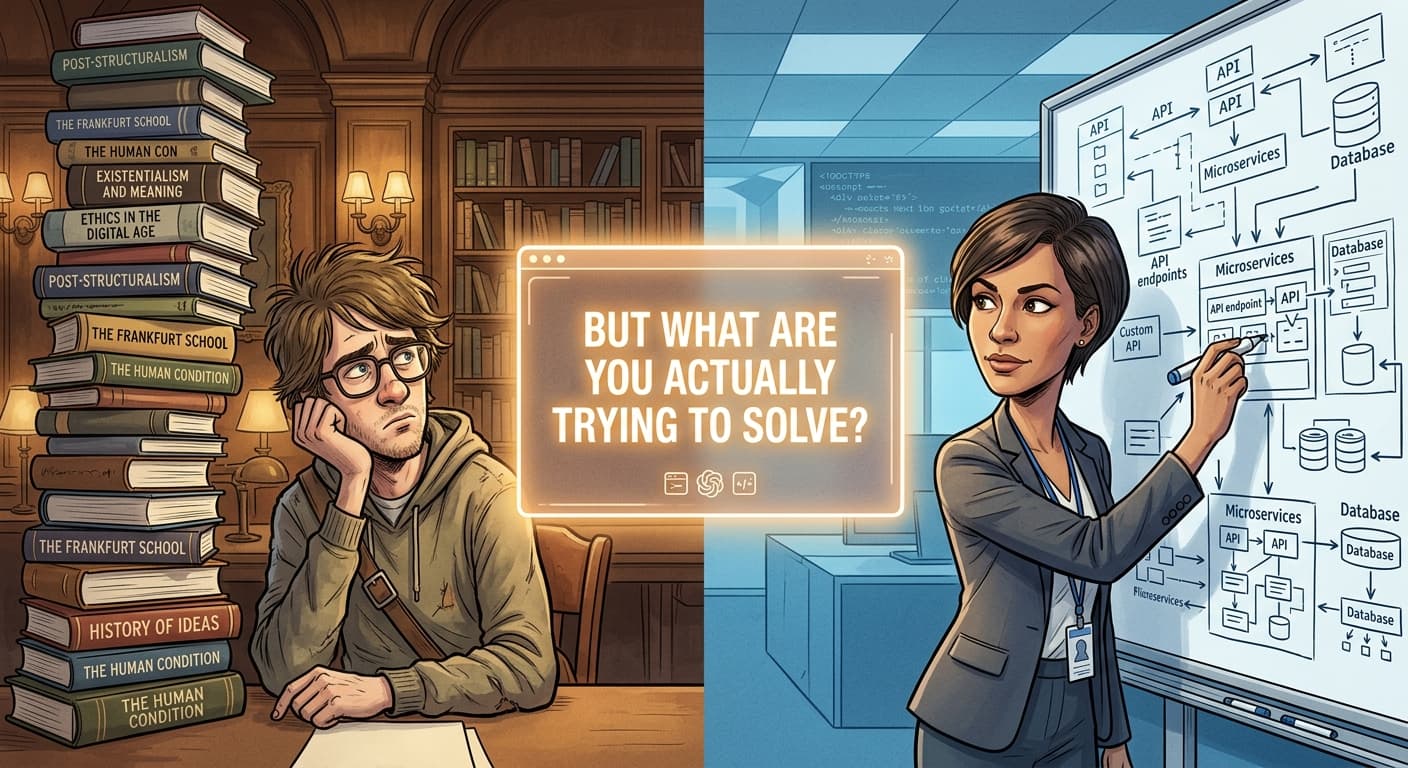
There is a pattern I keep seeing as AI tools become part of everyday work.
People learn the mechanics first. How to write a prompt. How to chain steps together. How to get the model to output a table instead of an essay. How to iterate when the first result is wrong. How to get it to sound more professional, or less formal, or more concise.
None of that is bad. The mechanics matter. But they're the wrong starting point.
I've been sitting with this for a while now, and I think the reason it bothers me is personal. It connects to things I studied years ago, things I'm watching play out in my own household, and a slow realisation about the kind of thinking that actually makes technology useful versus just fast.
What AI can and can't do
Jeff Crume put out a piece recently that articulated something I'd been circling around without quite landing on.
His argument is this. AI can generate answers. Impressive ones. Confident ones. Well-structured, clearly expressed, rapidly produced answers. But the model doesn't know what you're trying to accomplish. It doesn't know why the problem exists, who it affects, what constraints matter, or what a good outcome actually looks like in your specific context.
That knowledge has to come from you. And it has to come before you touch the tool.
This is where most people get stuck without realising it. They assume that if they learn the how well enough... if they get good enough at prompting, at structuring their inputs, at iterating on outputs... the what and the why will somehow take care of themselves.
They don't. They never have. AI just makes the gap more visible.
The model is extraordinarily good at producing the how. It is entirely dependent on you for the what and the why.
The disciplines we undervalued
Here's where it gets interesting. And a little uncomfortable for those of us who came up through technical education.
The humanities... philosophy, history, sociology, ethics, literature... are not decorative disciplines. They are not the soft option. They are the disciplines specifically and rigorously built to ask what and why.
What does this mean? Why does it exist? Who is it for? What are the assumptions underneath it? What happens when those assumptions are wrong? Why does this matter to the people it affects?
These are not vague questions. They require genuine intellectual rigour to answer well. And they are exactly the questions that determine whether an LLM produces something genuinely useful or something impressive that entirely misses the point.
The tech industry has spent decades treating these disciplines as peripheral. As the things you study if you can't do the real work. As nice-to-have context rather than essential capability.
I think AI is in the process of proving that wrong. Loudly.
What I see at home
I have a son at university studying humanities.
Watching how he approaches a problem is genuinely different to how I was trained to approach one. He doesn't start with methods or frameworks or tools. He starts with questions. What is this actually about? Why does this position exist? Who benefits from it being framed this way? What am I being asked to assume, and should I?
He challenges the structure of a problem before he starts working inside it.
When I did my undergrad in Information Systems, the approach was almost the opposite. Here are your tools. This is the methodology. This is how it's done here. Apply it correctly and you'll get a good outcome.
Critical thinking about the problem itself wasn't really part of the curriculum. We were trained almost exclusively for the how. And at the time, that felt like rigor. It felt like we were being taught the real thing, not the soft thing.
I didn't fully appreciate the gap until now.
Watching my son think, and then watching how most technical teams approach AI adoption, I keep seeing the same contrast. The technical approach starts with the tool and works backward to the problem. The humanities approach starts with the problem... really sits with it... and only then asks what would be useful.
One of those produces faster outputs. The other produces better ones.
What my research taught me
My honours research sits at the intersection of these two worlds. I was looking at how culture operates at different levels inside an organisation, and how IT change initiatives landed differently depending on which level you were trying to shift.
What I found, and what has stayed with me ever since, is that the technical change was almost never the hard part.
The hard part was always the layer underneath it. The assumptions people carried about why work was done a certain way. The unspoken logic that made the old process feel necessary and the new one feel threatening. The values and beliefs that shaped how people interpreted what the change was even for.
Most organisations changed the how and left the why completely untouched.
They implemented new systems into old thinking. And then wondered why the outcomes didn't match the investment.
The technology worked. The change didn't. Because nobody had asked the right questions before the implementation started.
Twenty years later, I'm watching the exact same dynamic play out with AI.
The pattern repeating
Teams are learning to use the tools. They are not asking what they are actually trying to accomplish, or why the old approach existed in the first place, or whether the old approach was the right one to begin with.
They are automating tasks without questioning the tasks.
And AI is very good at helping you do that. It will help you produce the old thing faster. It will help you generate the familiar output with less effort. It will optimise for the process you already have, rather than the process you should have.
This is not the model's failure. It's a failure of the what and the why upstream.
A solutions architect who uses an LLM to generate a diagram faster is still thinking in diagrams. The more important question is... does this still need to be a diagram? What is the diagram actually for? Who is reading it, and what decision does it need to support? Is there a better way to communicate this, now that the tools allow for different possibilities?
When you start there, the tool becomes something different. Not a faster typewriter. A thinking partner for a problem you've properly defined.
The quality of what you get out of an LLM is almost entirely determined by the quality of what you bring to it. And quality, in this context, means clarity about what you're trying to accomplish and why.
The organisational version of this problem
Individual clarity is necessary but not sufficient.
Because organisations have the same problem at scale. And organisational culture, as my research made clear, operates at multiple levels simultaneously. The surface level is visible. Processes, tools, outputs, metrics. Below that are the values people articulate. And deeper still are the assumptions people hold without knowing they hold them. The things that feel like common sense because they've never been questioned.
AI adoption is happening at the surface level in most organisations. New tools. New workflows. New ways of producing familiar outputs.
The deeper levels are largely untouched.
And this is where it becomes expensive. Because a well-implemented system inside a poorly-understood process just creates a faster version of the wrong thing. The culture around the work... the assumptions about what good looks like, the habits around how decisions get made, the unspoken rules about what's worth questioning and what isn't... those things don't change because the tool changed.
The what and the why have to be answered at the organisational level. Not just by individuals.
What are we actually trying to do here? Not with AI specifically. With the work itself.
Why does this process exist? What would we design if we were starting from scratch, with the tools we now have?
These are uncomfortable questions. They require people with authority to sit with the possibility that some of what currently exists is legacy habit rather than deliberate design. That some of the how was always somewhat arbitrary, and the organisation just got used to it.
But they're the only questions that make the how worth asking.
Who will get the most from this
I've thought a lot about what actually separates the people who use AI well from the people who use it to produce more of the same.
It's not technical sophistication. It's not the ability to write clever prompts. It's not even experience with the tool.
It's clarity about what they're trying to accomplish and honesty about why.
That's a thinking skill. And it turns out the disciplines that have been training that skill for centuries are exactly the ones the tech industry spent decades treating as peripheral.
Crume's point lands here. The humanities aren't important because AI raises ethical questions, although it does. They're important because asking what and why, rigorously and honestly, is what they actually do. It's the core of the practice.
The people who will get the most from AI are the ones who can define the problem before they reach for the tool. Who can question the assumption that the familiar output is still the right output. Who can sit with a why until they actually understand it, rather than moving straight to the how because the how feels like progress.
That clarity has always been rare. AI is making the gap between people who have it and people who don't... more visible, faster.
Where I've landed
I'm not arguing against technical education. I'm not arguing that the how doesn't matter.
I'm arguing that the how, on its own, was always insufficient. And that we're in a moment where that insufficiency is becoming impossible to ignore.
Watch someone who has been trained to think in the humanities approach an AI tool. Then watch someone who has only ever been trained in technical methods approach the same tool.
The difference isn't in the outputs they can produce. It's in the questions they ask before they start producing.
My son doesn't know he's demonstrating something important every time he sits down with a problem. But he is.
The how is a commodity. It always was, really. What's changed is that AI has made that obvious.
The what and the why are still yours to figure out. And if you want to get better at them... really better, not just faster... you might need to look somewhere other than a technical manual.
Are you starting with the problem or starting with the tool? I'd genuinely like to know.
The Not Architect is a blog about technology, organisations, and the thinking that sits underneath both.