The Feedback Sandwich Is a Lie — and Everyone Knows It
The feedback sandwich was never for the person receiving feedback. It was for the manager who couldn't bear to just say the thing.
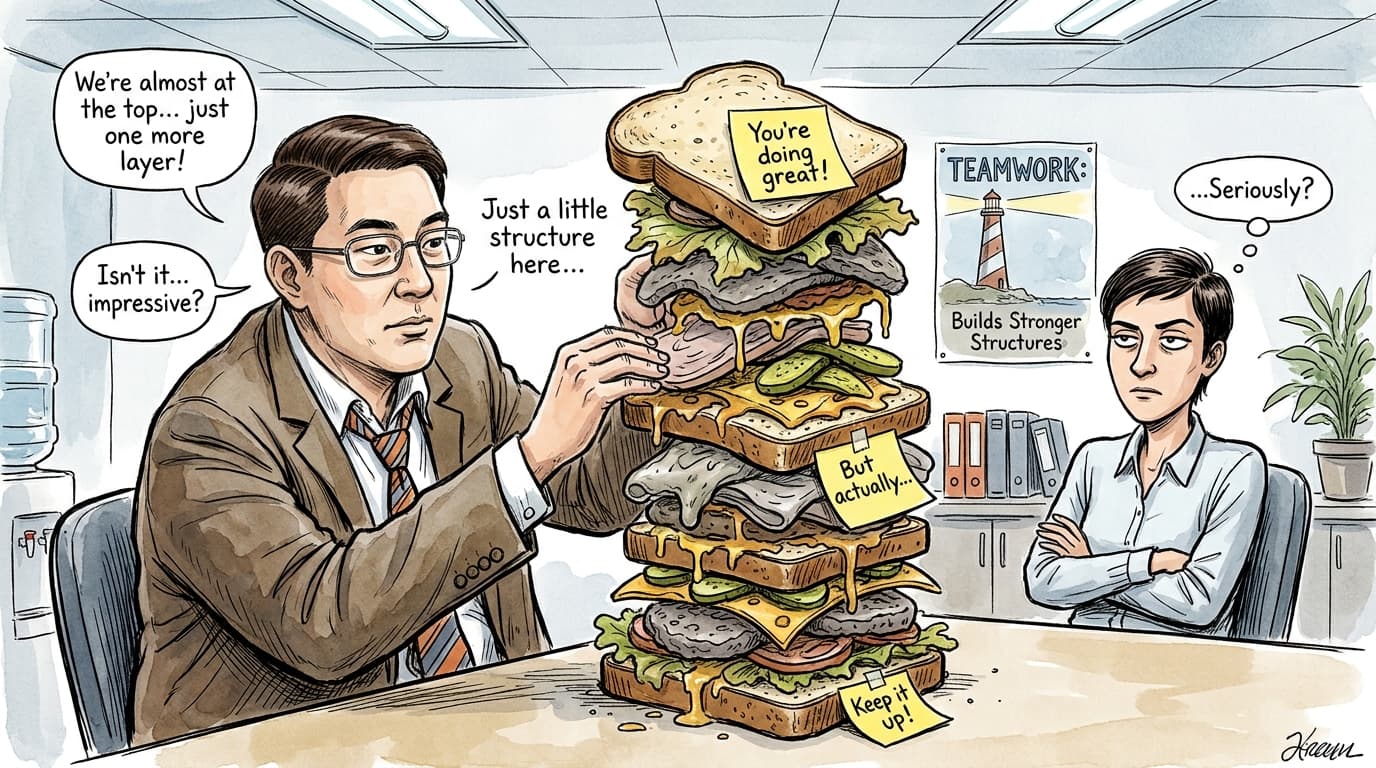
You know the move. You've been on the receiving end of it. You may have even deployed it yourself, slightly ashamed, in a one-on-one you wished you could reschedule.
Positive thing. Critical thing. Positive thing.
The feedback sandwich. Management's favourite comfort food.
And it doesn't work. Not because the technique is flawed in execution, but because it was designed to solve the wrong problem.
What the sandwich is actually for
When you reach for the feedback sandwich, you are not thinking about the person sitting across from you. You are thinking about yourself.
You are thinking about how uncomfortable this conversation is going to be. You are thinking about the awkward silence after you say the hard part. You are thinking about whether they'll be upset, whether they'll shut down, whether they'll start updating their CV during the afternoon standup.
The positive bookends exist to soften that discomfort: yours, not theirs.
This is not speculation. There is decades of management literature pointing at the same conclusion: the feedback sandwich is a technique developed for the deliverer, dressed up as a courtesy to the receiver. You wrap the criticism in praise so you feel less like a villain. The person on the other end is supposed to feel cushioned. What they actually feel is confused.
Why it fails
Here is what happens in the other person's head:
"She said the client presentation went well, the data visualisations were really effective - oh, here it comes - I need to work on my preparation time, I had some facts wrong under questioning - okay, okay - and she appreciated how I handled the follow-up questions at the end."
Two things are now happening simultaneously. First, they are waiting for the bad news the moment the good news starts. The first positive lands as a false preamble. They are not receiving it; they are bracing for what follows it. By the time you get to the actual criticism, the positive has been discarded as throat-clearing.
Second, the structure communicates something unspoken: this is so bad I needed to pad it. The elaborate framing signals that the critical part is more severe than you're letting on. The sandwich inflates the feedback it was meant to soften.
And the second positive, the reassurance at the end, is the part you'll both walk away from feeling good about, which means you've inadvertently buried the thing that actually mattered.
The trust problem
Do this enough times and you train your team.
Not to receive feedback well. To distrust your praise.
Once the pattern is established, and people catch on quickly, usually after the second or third sandwich, any positive feedback you deliver starts to carry a question mark. "Is this the opening of a sandwich?" They will listen to your praise with one ear on the door, waiting for the but.
You have now made genuine appreciation carry a tax. The moments where you genuinely want to say "that was excellent and I have no notes" are tainted by every time you used the same opening as a set-up.
This is the compounding cost that never shows up on anyone's management training slide deck.
What it signals about your organisation
The feedback sandwich is a symptom, not just a practice.
When it proliferates, when it becomes the default mode of how people in a team or organisation give feedback, it usually means one of two things:
One: psychological safety is low. People do not feel safe giving direct feedback because directness has historically landed badly. Someone, somewhere, responded to criticism with hostility, or took it to HR, or quietly disengaged and the manager got blamed. The sandwich is the adaptation. It is a coping mechanism for an environment where straight talk is risky.
Two: the culture values comfort over growth. There is an implicit norm that avoiding upset is more important than having the conversation that needs to happen. This usually comes from the top. When leadership models softened, hedged, buffered communication, the rest of the organisation follows.
In both cases, the sandwich is the visible sign of a deeper problem. Eliminating the technique without addressing what drove people to it is rearranging furniture.
What to do instead
This is the part where I am supposed to give you a framework with a four-letter acronym.
I am not going to do that.
Here is what direct feedback actually looks like:
Observation, not evaluation. Say what you saw, not what it means about the person. "During the presentation you misquoted the Q2 numbers twice" is an observation. "You need to be more thorough" is an evaluation that will activate defensiveness before the conversation has started.
Impact, not catastrophising. Say what the consequence was. "The client noticed, and it cost us credibility on a point we should have owned." Not "this is a serious problem with how you approach your work."
Ask before you prescribe. "What do you think happened there?" is one of the most underused questions in management. You might discover that they were handed the wrong slides at 8am. You might discover that they know exactly what went wrong and have already thought through how to fix it. You might discover something you did not know. Talking first means you do not have to guess.
Separate praise from criticism. If you have something genuinely positive to say, say it on its own, at a time when it is genuinely warranted, without something else stapled to it. Make appreciation a complete sentence. Do not use it as a structural device.
None of this requires courage in the special-forces sense. It requires treating the person you are managing as an adult who can handle accurate information about their own performance.
The harder question
I have worked with managers who gave exceptional feedback, and the one thing they all shared was not a framework or a technique. It was a genuine belief that the other person could handle the truth and was better off knowing it.
The feedback sandwich, at its core, is the opposite assumption. It says: I do not trust you to hear this cleanly. I need to protect you, or myself, from the directness of what I have to say.
That assumption is where the real work is.
If you cannot say the critical thing without elaborate wrapping, the question is not how to arrange the sentences. The question is why you do not think the person in front of you is capable of handling honest feedback, or why you do not feel safe giving it.
Answer that and the sandwich becomes unnecessary.
A note on kindness
Directness is not unkindness. This is the misunderstanding at the centre of most bad feedback culture.
You can be precise and warm at the same time. You can say something hard and say it with care. The people I most wanted to work for in my career were the ones who told me clearly when something was wrong, not because they were unsentimental, but because they respected me enough to be honest.
A feedback sandwich is not kind. It is comfortable. Those are very different things.
The person who needs to grow does not need you to be comfortable. They need you to be clear.
Filed under leadership, because technically it is. Spiritually it is under "things I wish I had learned in year one."