Why Your Best Engineers Stop Talking in Meetings
Your senior engineers going quiet in meetings is not a personality trait. It is a learned response to what your organisation does with honest technical input.
There is a pattern that repeats in every engineering organisation I have worked in or consulted for.
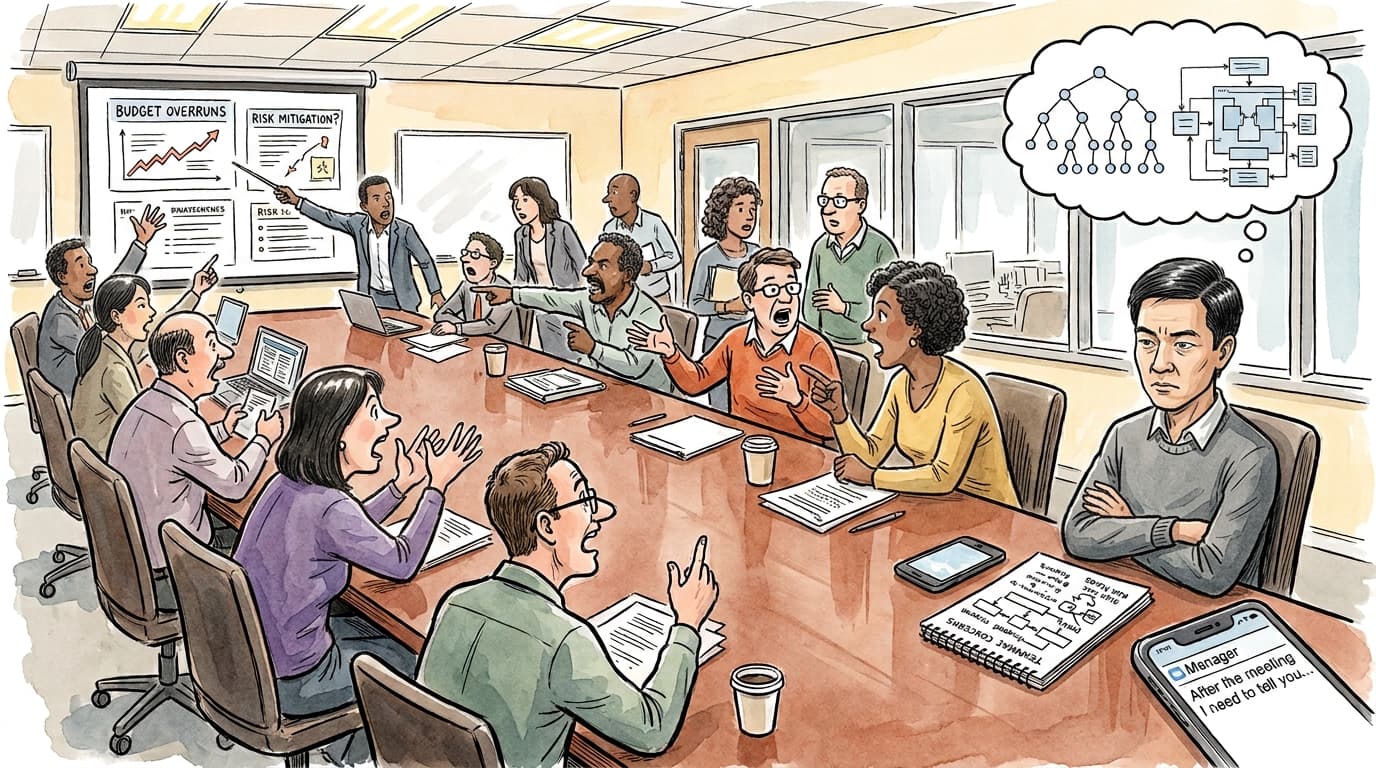
A senior engineer, the kind whose opinion you would genuinely want before any significant decision, sits through the entire meeting without saying a single word. They ask no questions. They raise no concerns. When the meeting ends, they message you privately with the five things that were wrong with what just got decided.
This is not shyness. This is a learned behaviour. And if you are running teams that produce it, you have a problem worth understanding.
What silence in a meeting actually means
Most managers read engineer silence as agreement, or at worst, disengagement. Both interpretations miss the point.
When a senior engineer goes quiet in a meeting, the most common reason is that they have already run the cost-benefit analysis on speaking up and decided the expected value is negative.
They know what happens when they raise a concern. It gets acknowledged, noted, and then ignored. Or worse: it derails the agenda, they get labelled as difficult, and the decision happens anyway with the additional tax that they are now the person who delayed it.
Silence is not disengagement. Silence is rational.
The meeting that trained them to stop
The silence you are observing did not happen spontaneously. It was trained into them by specific experiences.
The most common one: they spoke up once, clearly and with good reason, and either the room moved on without engaging with what they said, or someone senior dismissed it without explanation, or it got "taken offline" and never came back.
You might not remember the specific meeting. They do. Every senior engineer I have spoken to can recall, with precise detail, the moment they decided it was not worth it anymore.
The second training mechanism is subtler. They watched what happened to someone else. They saw a peer get pushed back on, talked over, or ignored, and they updated their model of what this organisation does with honest technical input. The training does not require personal experience; observation is enough.
The status update trap
A significant contributor to engineer silence is the design of the meetings themselves.
Many engineering meetings are structurally incapable of producing useful input from senior people. They are designed for status reporting, not decision-making. Progress updates, blockers, sprint reviews, standups that run long: these formats do not invite the kind of thinking that good engineers do best.
When meetings are primarily information broadcasts, the rational move for someone with genuine technical insight is to say nothing. There is nothing to contribute because there is nothing being decided.
The engineers who talk most in these meetings are often not the most useful people in the room. They are the people comfortable filling space. Your senior engineers, the ones with the clearest mental models and the highest pattern-recognition, are usually allergic to noise for its own sake.
If your meetings are mostly status updates, you are optimising for the people who like talking and filtering out the people who like thinking.
When "let's take it offline" becomes a signal
Pay attention to what happens to technical concerns raised in meetings at your organisation.
"Let's take that offline" is often well-intentioned. It can genuinely mean: this is important and deserves more space than we have right now. But it can also mean: I want this conversation to stop happening in front of everyone.
Over time, your engineers will read which one it is. If "let's take it offline" reliably means the topic disappears, or gets resolved without them, or comes back as a decision already made, they will stop raising things that get taken offline.
The pattern completes itself. Engineers stop surfacing issues in meetings because the mechanism for handling those issues is unreliable. Leadership interprets the absence of raised issues as a sign that things are going well.
The cost of losing those voices
The business case for fixing this is not abstract.
The engineers who go quiet are not randomly distributed. They are disproportionately the engineers with the most context, the longest tenure, the deepest understanding of what was tried before and why it failed. They are the people most likely to catch the assumption error in your migration plan or the integration risk in a new architecture.
When they stop talking in meetings, you do not lose their opinions on project timelines. You lose early warning on the things that will actually hurt you.
They also tend to be the engineers that other engineers go to for informal technical guidance. When they disengage from the visible conversation, they often reduce their investment in the broader team as well. The disengagement is rarely contained.
The most dangerous version of this problem is also the most common: the engineer has not resigned, they have not escalated, they are not visibly unhappy. They are simply doing their job, attending meetings, saying very little, and updating their CV.
What to do about it
The interventions that actually work are structural, not motivational.
Design meetings for decisions, not updates. If there is nothing to decide, cancel the meeting or replace it with asynchronous communication. When meetings are reserved for choices that need input, the people with the best input will show up for them.
Circulate context before the meeting. Senior engineers do their best thinking before the room assembles, not in response to live pressure. A document shared twenty-four hours in advance, with a clear question for the group to answer, changes the quality of what happens in the room.
Create a mechanism for concerns to be tracked and closed. If someone raises a technical risk, the organisation needs a visible way to say: we heard it, we considered it, here is what we decided and why. This is not bureaucracy. It is the thing that makes raising concerns feel worth doing.
Notice who is not talking and ask directly, privately. Not in the meeting, where public asking creates public pressure. Afterwards, individually: "I noticed you didn't say much in there. Was there something you were holding back?" Give them a safe route to the thing they already told you in that private message after the meeting.
The harder question
If you have engineers who have gone quiet, the honest question is not "how do I get them talking again in meetings."
The honest question is: what happened to make it rational for them to stop?
That question points to specific incidents, specific patterns, specific things the organisation does with technical input that made silence the better choice. Those things are the actual problem. The meeting silence is just the visible symptom.
The engineers who have gone quiet have not lost their opinions. They have simply stopped sharing them with you. Some of them are sharing those opinions with recruiters.
Filed under leadership, because the best technical decisions I have seen came from rooms where the quietest person finally said the thing.